


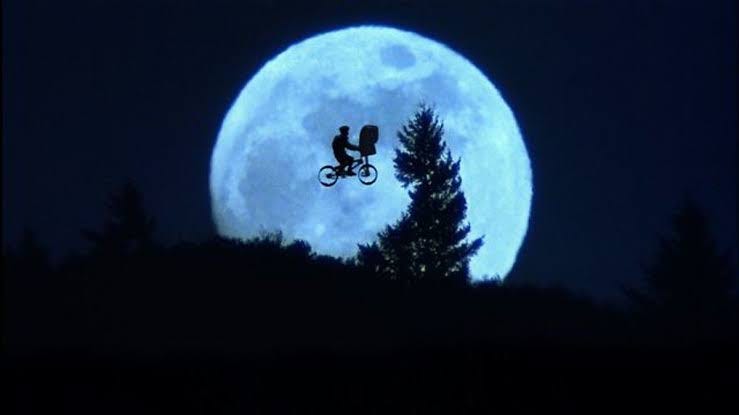
Age Recommendation: Probably 10 and up, maybe even 12 and up depending on what your tolerance is for language in movies at that age. Teenagers occasionally make crude references and some occasional strong language. It’s also pretty emotionally intense for young children.
(Nota Bene: Just a friendly reminder that the goal of this Substack is to create a list of movies for families of all different age makeups, so occasionally there will be films skewed towards families with primarily older children. I would say thus far all films have been pretty much for all ages.)
Years before he adapted the story of “Peter Pan” with Hook, Steven Spielberg made his own fairy tale story, set in the suburbs of 1980s California. It focused on a 10 year old boy named Elliott: instead of a fairy godmother, he had a short, wrinkly alien who he dubbed “E.T.”
For those who don’t know, Spielberg was a child of divorce: therefore a lot of his movies feature characters whose parents are either split up or are in turmoil. Therefore the idea for E.T. actually spawned from his own childhood, as he created an imaginary friend who was an alien shortly after his own parents split, to fill the emotional void.
He had always planned on making a movie about this imaginary friend, originally titled Growing Up, but other movie ideas ended up getting in the way. It wasn’t until he was working long weeks in Tunisia on Raiders of the Lost Ark that he began to truly reminisce on his childhood, far away from his family and friends, leading him to revisit the idea.
Spielberg had already made two films about aliens: when he was 17 he made Firelight, about a mysterious alien encounter which got released in a local theater, and Close Encounters of the Third Kind. Close Encounters depicted the aliens as peaceful, inquisitive visitors, but the director had been thinking of making a follow-up called Night Skies, which would deal with less friendly, violent visitors.
To help him with the project, he employed screenwriter Melissa Mathison, who had worked on The Black Stallion, which was produced by Spielberg’s friend Francis Ford Coppola (The Godfather). He thought about folding in his Growing Up idea into the film, with a subplot about a friendly alien who befriends an autistic child. Soon the entire project shifted focus to the “friendly alien” subplot, and Matheson retitled the film E.T. and Me.
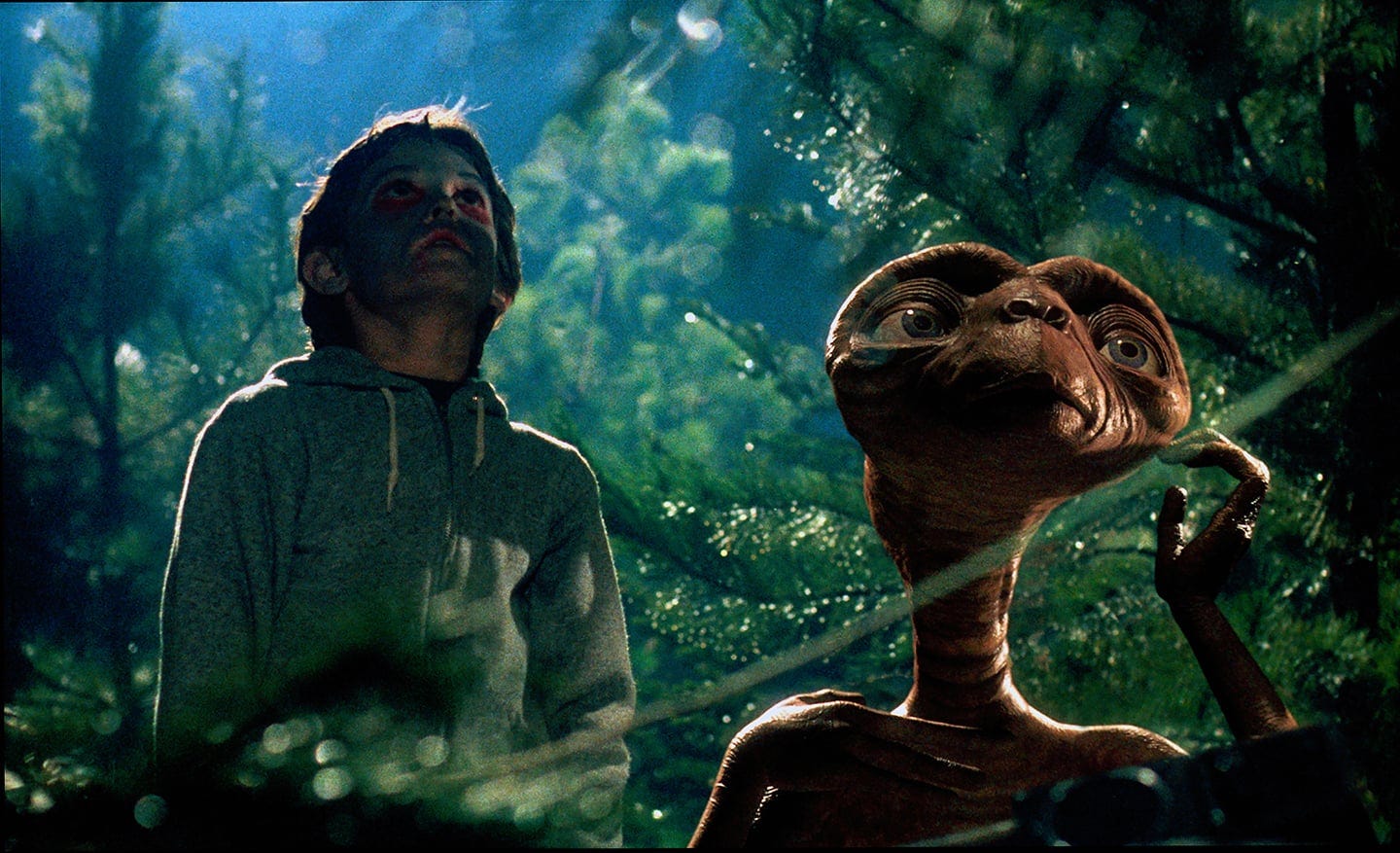
My parents showed me E.T. when I was probably around 7 years old, and I was entranced by it. Spielberg’s vision of suburbia felt like what childhood should be like, with kids traveling wherever they wanted via bicycle and gathering for pizza and Dungeons & Dragons on the weekends.
Getting older, I am astounded by the simplicity of Spielberg’s tale, and its realistic depiction of how children (specifically siblings) interact. The formula for this film has been oft-imitated (looking at you, Stranger Things) but never surpassed (except, perhaps, The Iron Giant), specifically because no imitator has had quite the same level of child actor as Henry Thomas as Elliott.
Thomas gives one of the most raw, emotional performances ever given by a 10 year old in a movie: part of what makes you believe that E.T. is real, aside from the incredible animatronic puppet developed by Carlo Rambaldi (who designed the aliens for Close Encounters) is Thomas’ performance. Watching him take his new alien friend through his room and showing him all of his toys is so endearing, and its amazing to watch E.T. go from being Elliott’s playmate to being a wise father figure.
Father figures abound in Spielberg’s films: Indiana Jones goes from losing his father figure of Abner Ravenwood to reuniting with his real father. Dr. Alan Grant acts as a paternal protector for Tim and Lex in Jurassic Park, leading him to change his stance on having a family. In E.T., Elliott’s father is gone in Mexico (with “Sally”) and he lives with his two siblings and single mother. His brother, Michael (Robert McNaughton) is still too young and immature to really be a paternal influence, but throughout the course of the film Michael comes to respect Elliott in a way he never did before and later invites him to play Dungeons & Dragons with him and his friends (in the beginning, Elliott is excluded from the table).
But a secondary father figure Elliott finds in the film is less-remembered, mainly because he never has a name: the script refers to him only as “Keys” and he’s played by Peter Coyote. Keys is one of the first characters we meet in the opening scene, where him and his fellow federal agents chase E.T. through the woods. Throughout the film we only see him from side-view, his entrance signaled by the keys dangling from his hip. We actually never see his face until Elliott and E.T. are in critical condition in the pop-up lab.
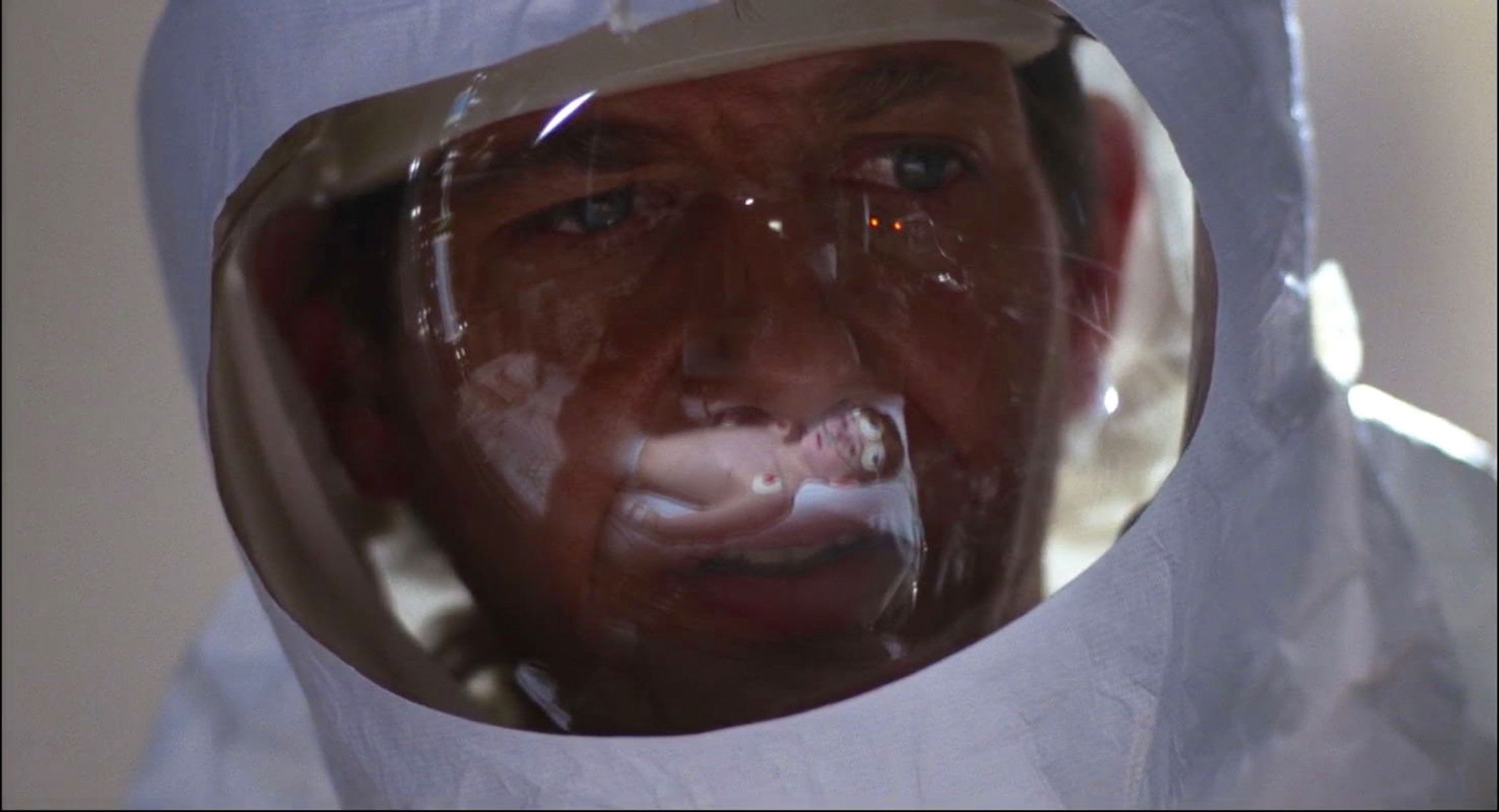
Throughout the film, adults are never shown by face, with the exception of Elliot’s mom (played by Dee Wallace), who is very much modeled after Spielberg’s own mother. So when the camera reveals the face of Keys (albeit through a clear protective mask) its a big deal. There’s something different about this guy. Their conversation goes like this:
KEYS: Elliot. I’ve been to the forest…Elliot that machine, what does it do? [referring to E.T.’s “phone”]
ELLIOT (weakly): The communicator…is it still working?
KEYS: It’s doing something. What?
ELLIOT: I really shouldn’t tell. He [E.T.] came to me… he came to me…
KEYS: Elliot…he came to me too. I’ve been wishing for this since I was 10 years old. I don’t want him to die.
For most of the adults in Elliot’s life, Elliot is either a nuisance or, in the case of the government scientists, a means to an end. As the movie progresses, he gains the respect of first his older brother, then Keys, and then his brother’s friends who invite him into their group. It is Elliot’s kindness towards E.T. that ultimately saves him, and this act of charity has a ripple effect in Elliot’s own community and personal circle, even restoring the childlike wonder of one of the cynical scientists.
It would be remiss of me not to point out the similarities between E.T.’s story and Christ’s mission on earth: both come down from the heavens, befriending us and teaching us while performing miracles. They both resurrect and then ascend back into the heavens, not before proclaiming that they will always be with us.
One wonders if Spielberg’s childhood “imaginary friend” was (and is) somebody else.
