


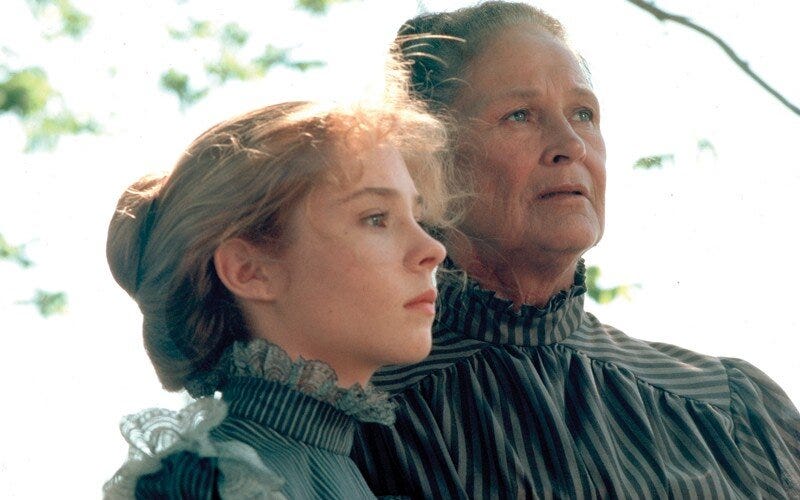
I don’t remember the first time I read or watched Anne of Green Gables, but I can say that the 1985 version has a special place in my heart. This version was originally a miniseries, and as such, is perhaps an overlong movie at 195 minutes. Miss Anne Shirley, however, will forever remain as one of my favorite heroines for her ordinariness, her charm, her determination, and her wit; 195 minutes didn’t seem to be enough for me.
The 1985 miniseries, starring Megan Follows and Jonathan Crombie, follows the Canadian heroine Anne, an orphan girl who is adopted by Marilla and Matthew Cuthbert, who are an elderly brother and sister living together on a farm called Green Gables, located on Prince Edward Island. It follows Anne as she grows up, making friends and rivals, as she allows herself to be carried away by both her imagination and her temper. Like the book it is based on, the plot is more episodic than purely linear, with many one-off incidents that fit well into episode format. This is part of what makes this “movie” so charming–real life often doesn’t feel like it has a resolution, which makes Anne’s adventures feel more relatable.
Anne was well-known for getting herself into lots of scrapes, but the wonderful thing about her was that all of her problems, even though they were technically her fault, felt entirely reasonable. One of her elderly neighbors said that Anne was skinny and had red hair, directly to Anne’s face, and she was supposed to take this lying down? Absolutely not! The fiery outburst was completely justified. She broke a slate over Gilbert Blythe’s head? Well, this was actually the only course of action, as he had grabbed her dreaded red hair and teased her by calling her “Carrots!”
While I related very much to Anne’s temper, one thing that I longed for was her imagination. She could imagine that she was happy when she was perfectly wretched (or at least was able to imagine friends who could help her through wretched times), and could take mundane, ordinary things and help people see them in a new way. When Matthew, Anne’s adopted father, brings her to Green Gables for the first time, she is stunned by the beautiful apple trees in bloom, calling it “The White Way of Delight.” She could imagine just about anything, even to distraction. When taking a necessary shortcut in the woods one afternoon, she frightens herself to the point of fainting by convincing herself there are spooks in the shadows. Anne is often carried away by her imagination, leaving her household tasks because something wonderful flitted by and it captured her fancy. It’s one of the things that drives Marilla crazy. She has very little room for romance in her life, what with being Matthew’s practical sister and Anne’s adopted mother.
Obviously, as a grown-up now, I can see why Anne’s scrapes were problematic, but when I was Anne’s age, I understood her. Her temper was reasonable, as I felt mine was when I was young, and the world of adults felt like it had standards that were a bit too high. Apologize to the neighbor? Perish the thought! However, while letting your temper win is the tempting option, learning how to control it and even apologize for it are actually good skills to learn. And even though I wanted Anne’s imagination, even I had to admit it got her into trouble sometimes. Case in point: Anne and her friends are playing with an old boat, where Anne plays dead to imitate a poem. The boat springs a leak while Anne floats down the river, where she grabs onto a piling and waits for rescue. Meanwhile, Anne’s friends find the boat half submerged, assume Anne has drowned, and begin to sound the alarm while Anne has to do the mortifying thing of swallowing her pride by allowing Gilbert (yes, that Gilbert) to rescue her.
There were, however, many things about Anne that were worth imitating. She was no stranger to hard work. It’s well known that Anne is an orphan, and before she came to live at Green Gables, she was helping a woman with many children keep house. This experience comes in handy when Diana (Anne’s best friend) comes to Anne panicking–Minnie May, Diana’s sister, is sick with the croup and her parents are gone. Anne flies off to help, because she knows exactly what to do. You see, this woman had many croupy babies, and as this woman had too many babies and not enough hands, Anne was forced to help care for them. Anne diligently stays by Minnie May’s side all night long until the doctor arrives, saving the baby’s life. She might be flighty when it comes to housework, but she can focus when needed.
Her focus is not only on amateur nursing skills, but on her schoolwork. It becomes clear that Anne has quite the head for knowledge on her shoulders as she grows up, and under the tutelage of Miss Stacey, she is able to get her scores high enough that she is able to go to college. Healthy competition with Gilbert (yes, still that Gilbert), pushes her to work hard for good grades, staying up late at night to cram for exams.
Speaking of Gilbert, he is a constant throughout the series after he teases Anne for her red hair. He apologizes, but Anne’s pride refuses to allow her to forgive him, even after he rescues her from the river. Her stubbornness keeps her from acknowledging Gilbert at all. Over time, Anne’s friends find her pride more and more unreasonable, despite still clinging to her childhood promise never to forgive him. Anne has a few humbling turns with Gilbert, and while they are painful (and somewhat cringey) to watch, they do have the effect of softening her hard heart. Gilbert grows into a good man, who, like Anne, has a great capacity for love, but it takes Anne longer to see it due to her temper.
I have always been charmed by Anne’s life. Her scrapes always seemed like so much fun, or at the very least, just a little bit romantic. I watched her life because while I never got into the trouble that she did, I always secretly wished that I could, because the stories would have been so fun to recount later. Her gratitude at simply being alive is inspiring, and it was infectious to all who encountered her. Marilla and Matthew had such quiet, practical lives before adopting a red-headed orphan girl. And while Marilla might have insisted otherwise, she genuinely loved Anne and her perspective on life. Be grateful, be passionate about everything, and be inspired by the wonderful things around you. And be wrong–sometimes–but eventually allow yourself to be changed by learning that you were wrong. These are the lessons that I have taken from Anne, and the ones I hope my children will someday learn after they stop laughing at her ridiculous troubles.

I remember watching this mini-series in middle school. Before that, they took us to a dinner theater production of it. Strangely, I don't remember us ever reading the book itself. 🤔