


Age Recommendation: There is a little blood when Peter fights Hook and when Hook shoots one of his men, so perhaps older kids.
“When I was a child, I talked like a child, I thought like a child, I reasoned like a child. When I became a man, I put the ways of childhood behind me.”
1 Corinthians 13:11
Peter Pan; or, The Boy Who Wouldn’t Grow Up was a play by writer J.M. Barrie that debuted in 1904. In 1911, he published a novel of the story originally called Peter and Wendy. For over 100 years, there have been many adaptations of this story across various media. On film, the first adaptation was a silent movie released in 1924. The most well-known is the 1953 animated film produced by Walt Disney. Then, 50 years later, there was the live-action movie directed by P.J. Hogan. In my opinion, this is one of the most notable. It’s a real shame that it was unsuccessful at the box office. The best family films appeal to both the children and the grown-ups (hence, entertaining the whole family). I don’t think the 2003 version of Peter Pan is a masterpiece, but I do believe that it is an overlooked gem that works on both levels. That is most fitting, considering the story’s main theme about the transition of childhood to adulthood.
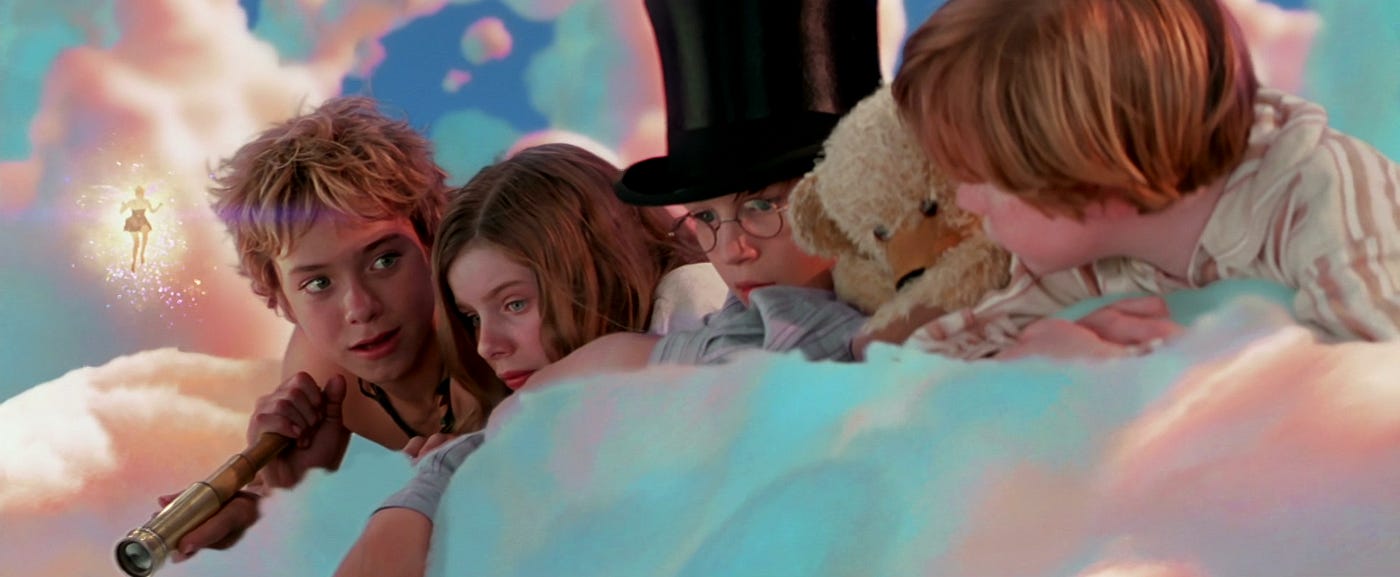
The kids will enjoy the movie for several reasons. An enchanting, playful mood permeates everything in the production. The fanciful rendering of old-time London and, certainly, the painterly look of Neverland will undoubtedly delight the eyes. This is enhanced by the vivid cinematography. The visual effects show their age a little, but that’s okay since this is a children’s fantasy. The musical score, by the one and only James Newton Howard, wonderfully accompanies the film. The theme “Flying” absolutely matches its name and lifts my spirits. When I was younger, I used to listen to it sometimes to simply brighten myself.
The child actors give fine performances, particularly Jeremy Sumpter as Peter Pan (surprisingly, the first boy to play the role in live-action on stage or screen) and Rachel Hurd-Wood as Wendy. Ludivine Sagnier shines, literally and figuratively, playing the fairy Tink. Olivia Williams is so warm and kind as Mrs. Darling. She has a splendid scene in which she tells her children that their father is a brave man because of the sacrifices he made for his family. Speaking of which, the true stand-out is Jason Isaacs as Mr. Darling and Captain Hook (they’ve always been played by the same man), who couldn’t have been better cast. He proved to be a great, ice-cold villain three years prior in The Patriot, but here he actually brings some nuance to the classic character. Witness the scene when Hook sees Peter and Wendy dancing in the air surrounded by fairies. The longing in his face and dialogue shows a facet of sadness and loneliness in Hook that I have never seen before.
With that, we come to the aspects of the film that the adults will appreciate. I haven’t seen all of the iterations of Peter Pan, but is there one that understands and dramatizes the themes and subtext of the story like this one? Wendy is about 12 years old. A part of growing up involves developing romantic feelings for the opposite sex. When they first talk to each other, she clearly has a crush on Peter and tries to give him a kiss but no luck. This is paid off spectacularly near the end of the movie.
All adults remember what it was like to be a child feeling anxious about growing up. We wanted to be like Peter Pan, staying young forever and not worrying about the responsibilities of the world. As Peter whispers in her ear, “Forget them, Wendy. Forget them all. Come with me where you’ll never, never have to worry about grown up things again.” She responds, “Never is an awfully long time.” In the middle of the film, after the aforementioned scene with Peter and Wendy dancing, they have an important conversation about love and adulthood:
“Peter, what are your real feelings?”
“Feelings?”
“What do you feel? Happiness? Sadness? Jealousy? [...] Anger? [...] Love?”
“Love? [...] I have never heard of it.”
“I think you have, Peter. I daresay you’ve felt it yourself for something... or someone.”
“Never. Even the sound of it offends me.” She tries to touch his face, but he flies backward: “Why do you have to spoil everything? We have fun, don’t we? I taught you to fight and to fly. What more could there be?”
“There is so much more.”
“What? What else is there?”
“I don’t know. I think it becomes clearer when you grow up.”
“Well, I will not grow up! You cannot make me!”
Sometimes we adults will look back wistfully on childhood, but we know that maturing is an inevitable and necessary step to deeper, more substantial experiences (such as true love). This is even attested in Sacred Scripture (see the quote by St. Paul at the top). I think this is the main message from the original story that the movie emphasizes. Because Peter blatantly refuses this, there is a kind of tragic quality to his character. At the end, when Peter looks at the Darling family together, the narrator says, “Peter Pan had countless joys that other children could never know, but he was looking at the one joy from which he must be forever barred.”
The 2003 cinematic version of Peter Pan is a worthy addition to the works inspired by the classic tale. It’s a fun, entertaining, and beautiful fantasy adventure for children and the young at heart. However, it also has layers that are interesting to contemplate for those of us who are older. I firmly believe that it deserves more attention.
